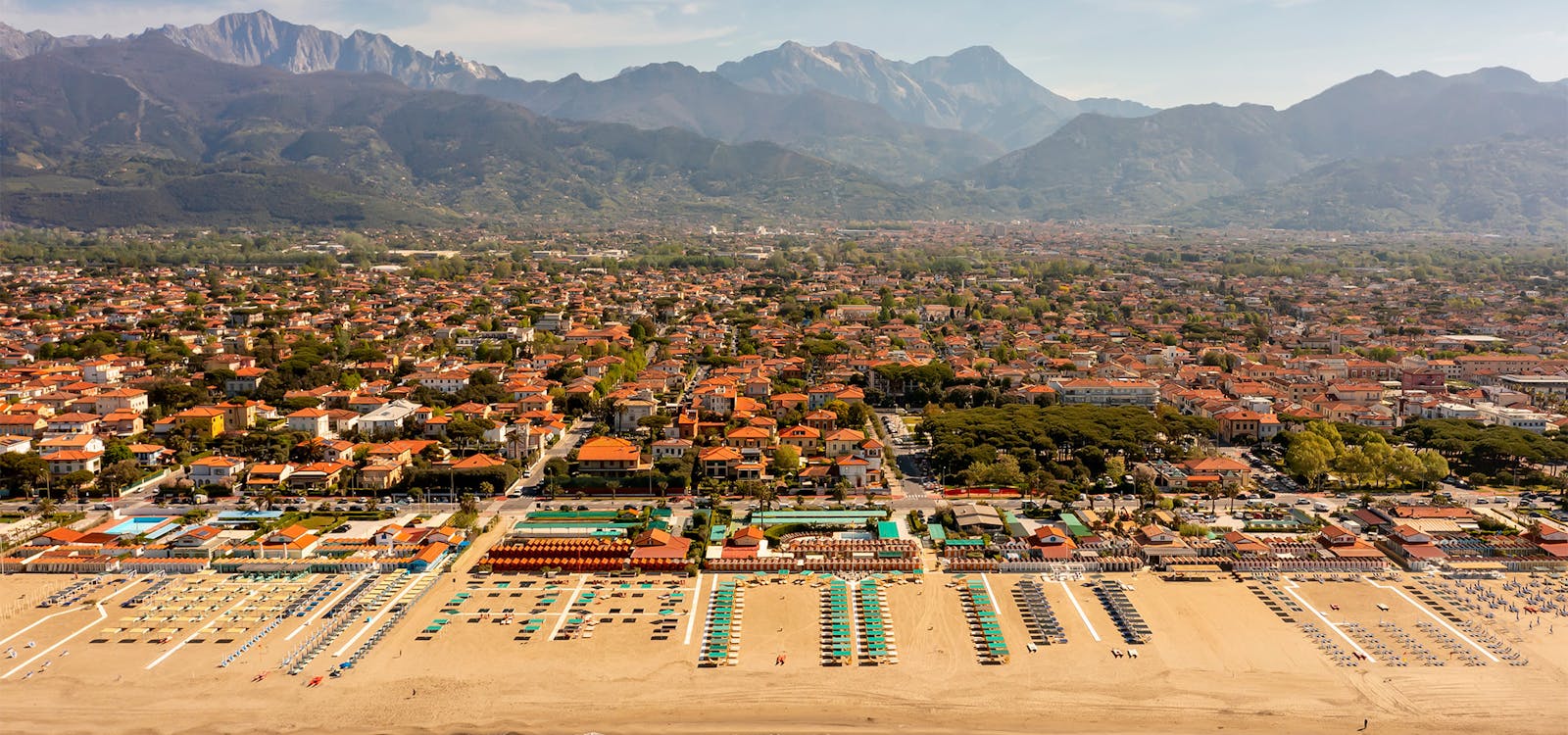
Versilia
A world to discover
Twenty kilometers of beaches. Dramatic mountain peaks. Endless olive groves. Vineyards, vegetable gardens, and flower fields. The lake beloved by Puccini. The countryside and hills once cherished by Carducci. Seascapes immortalized by Carrà. Lively seaside resorts frequented by the beau monde, art cities, and small mountain villages where time seems to stand still. Versilia is a world to be discovered, at any time of year.
The emotion of a stay in Versilia
The other municipalities of tourist Versilia
SERAVEZZA
About 4 kilometers from Forte dei Marmi, at the confluence of the Serra and Vezza streams, lies Seravezza. It can be reached by following the Marina provincial road from the center of Forte dei Marmi. Seravezza is home to the elegant Medici Palace, with its garden and the Grand Ducal Stables, an imposing 16th-century residence of the Florentine Medici family, now a venue for cultural events. The Municipality of Seravezza offers remarkable landscape variety: the plains with the towns of Querceta, Ripa, and Pozzi; the valley floor with Seravezza itself, Ruosina, and Riomagno; and the mountainous area dotted with small, picturesque, and historic villages such as Fabiano, Giustagnana, Basati, and Minazzana, nestled among cool chestnut forests. Particularly noteworthy is the hamlet of Azzano, dominated by Mount Altissimo in the Apuan Alps. At the edge of the village, in the locality of La Cappella, stands an ancient parish church whose façade features a striking rose window attributed to Michelangelo Buonarroti, who frequented the area in 1518 while selecting marble for commissions from Pope Leo X of the Medici family. Seravezza and Upper Versilia offer numerous outdoor activities for those seeking relaxation away from the beach: hiking at all levels, family-friendly experiences, and sports for more advanced enthusiasts, such as cycling tours, mountain biking, horseback riding, and sport fishing.
Tourist Information Office: Phone +39 0584 757325
www.prolocoseravezza.it


STAZZEMA
The territory of Stazzema lies entirely within the Apuan Alps. Its villages, scattered across hills and mountains, offer sweeping and evocative views. The small hamlet of Sant’Anna, the site of a tragic Nazi massacre in August 1944, is now home to the National Peace Park, dedicated to the memory of the victims and to the promotion of peace and cooperation among peoples. From the villages of Pruno, Volegno, and Cardoso, visitors can admire the striking peaks of Mount Pania della Croce, Mount Forato, Mount Corchia, and Mount Procinto. Streams and mountain torrents flow down from the Alps, enriching the surrounding forests and villages – pristine landscapes best explored by car, bike, or, above all, on foot along wide, well-marked trails. A particularly suggestive event takes place during the summer solstice, when the sun aligns perfectly with the natural stone arch of Mount Forato, a phenomenon visible even from the beach of Forte dei Marmi. On Mount Corchia, an underground route of about two kilometers allows visitors to safely explore spectacular karst caves, ancient stalactites, and stalagmites.

PIETRASANTA
Pietrasanta is internationally renowned for artistic marble and bronze craftsmanship. Artists from all over the world come here to learn and hone these techniques in the town’s many art workshops. Founded in 1255, Pietrasanta is also the birthplace of poet Giosuè Carducci. Its historic center revolves around a central square overlooked by the beautiful 13th-century Cathedral of San Martino, the deconsecrated Church of Sant’Agostino – now a venue for temporary art exhibitions – the Civic Tower, and the Rocchetta Arrighina. In summer, the square becomes an open-air museum of rare magic, hosting monumental sculptures and artworks. Above the square rises the Rocca di Sala, crowned with crenellated walls and situated on an easily accessible hill. Pietrasanta is also a renowned seaside destination, characterized by elegant villas set amid the greenery of pine groves. Nearby, in the Versiliana Park, visitors can tour the villa where poet Gabriele D’Annunzio spent his Versilia summers in the early 1900s. Today, the Villa and park host events and performances in an open-air theater.

CAMAIORE
The territory of Camaiore includes the southern reaches of the Apuan Alps, with peaks such as Mount Prana, Matanna, and Gabberi, as well as rolling hills descending toward the coastal plain. The area is mainly characterized by vegetable cultivation, vineyards, olive groves, and flower nurseries. Camaiore dates back to Roman times, when Campus Maior served as an important Roman military camp. Its prominence grew during the Middle Ages thanks to pilgrims traveling along the nearby Via Francigena. The area is dotted with numerous parish churches, including the Pieve of Santo Stefano and the Benedictine Abbey, both of significant historical value. Each year, during Corpus Christi celebrations, a procession passes along the main street from the Abbey, accompanied by intricate carpets made of colored sawdust portraying religious images. Not far from the town center, toward the coast, stands Villa Le Pianore, the famous birthplace of Princess Zita of Bourbon, the last Empress of Austria. On the seafront, Lido di Camaiore is a popular bustling beach destination known for numerous art exhibitions, music, and performances held in the Bussoladomani park.

MASSAROSA
Start your visit to Lake Massaciuccoli inland at the Roman villa, which features ancient thermal baths and a small archaeological museum. The park's entrance is marked by the Massaciuccoli Oasis, a perfect spot for beginning boat trips on the lake or strolling along designated boardwalks—great for birdwatching. Just outside Massarosa, the renowned and visually impressive Pieve a Elici features a prominent summer schedule of sacred and classical music. In the hillside villages of Bargecchia and Corsanico, the small parish churches also present very engaging musical seasons.

ph. Diego Laurino/©ForteMagazine (reproduction prohibited)
VIAREGGIO
Viareggio is famous for its Carnival, held along the seafront promenade in the heart of the city, where enormous papier-mâché floats parade – crafted in the nearby Carnival Citadel. The promenade is lined with many eye-catching Liberty-style buildings. Close to the waterfront promenade are Villa Paolina and the GAMC museums, featuring permanent collections of art and archaeology, as well as Villa Argentina, known for its exquisite Liberty-style colored ceramic decorations by Galileo Chini. It’s worth taking a break, whether by bike or on foot, in one of the large pine forests north or south of the town center, which feature areas for picnics and children’s play. Walking around the harbor and along the pier offers views of beautiful boats and yachts, showcasing the town's proud shipbuilding tradition, recognized as an activity of excellence. South of Viareggio lies a distinctive landscape of wetlands and Lake Massaciuccoli, which inspired composer Giacomo Puccini. In nearby Torre del Lago, Puccini lived and composed many of his operas. Each summer, the Grand Open-Air Theater Giacomo Puccini hosts an important opera festival dedicated to his works. The nearby Macchia Lucchese green area forms part of the larger Migliarino-San Rossore Natural Park, a coastal green belt stretching to Pisa and Livorno, where unspoiled nature is carefully protected.